
Undiscovered land contamination can destroy property investments through unexpected remediation costs and legal liabilities. Following Australia’s two-phase ESA framework allows investors to identify subsurface environmental risks early, price risks accurately, and protect capital before settlement.
Key Takeaways
- Phase 1 identifies plausible contamination through desktop reviews and visual site inspections without disturbing the land surface
- Phase 2 quantifies subsurface pollution using intrusive soil, groundwater, and vapour sampling when Phase 1 flags potential risks
- Australian liability rests with current owners, making staged due diligence essential to avoid costly post-settlement remediation surprises
Before you commit to a commercial, industrial, or development site in Australia, as an investor, you will face a critical due diligence question: How much environmental risk sits beneath the surface?
Environmental site assessments answer that question in stages, each with a different scope, cost, and level of certainty. This blog will help you understand what each stage delivers, and when one leads to the next so that you make sound decisions as investors.
Understanding the Two-Phase ESA Framework in Australia
Australia’s environmental due diligence follows a two-stage model, known as the Phase I Phase II environmental site assessment framework. Under the National Environment Protection (Assessment of Site Contamination) Measure (ASC NEPM), Phase 1 is technically a Preliminary Site Investigation (PSI) and Phase 2 is a Detailed Site Investigation (DSI).
Knowing which stage applies, and why, is the first step in protecting an investment. A Phase 2 ESA only proceeds once a Phase 1 has flagged a reason for concern; it is not a routine follow-on step.
| Aspect | Phase 1 ESA | Phase 2 ESA |
|---|---|---|
| Purpose | Identify whether contamination is plausible |
Confirm and quantify contamination |
|
Methodology |
Records review, database search, site walkover, interviews | Soil/groundwater/vapour sampling, drilling, lab analysis |
| Site disturbance | None (non-intrusive) |
Intrusive; boreholes, test pits, monitoring wells |
|
AU regulatory term |
Preliminary Site Investigation (PSI) | Detailed Site Investigation (DSI) |
| Typical duration | 1–2 weeks |
3–6 weeks (incl. lab turnaround) |
|
Key deliverable |
Risk classification + recommendation | Contaminant concentrations vs NEPM investigation levels |
| Governing standard | ASC NEPM Schedule B2 |
ASC NEPM Schedule B2 + AS 4482 sampling guidance |
Table 1: Phase 1 vs Phase 2 At a Glance
What a Phase 1 ESA Involves
A Phase 1 environmental site assessment is a desktop observational investigation; no drilling, sampling, or laboratory analysis.
- Historical land titles, aerial photography, council records, and government contamination registers are reviewed
- Physical site walkover and interviews are conducted with current or former occupiers
- The output is a documented risk classification with a clear recommendation on whether further investigation is warranted
What a Phase 2 ESA Involves
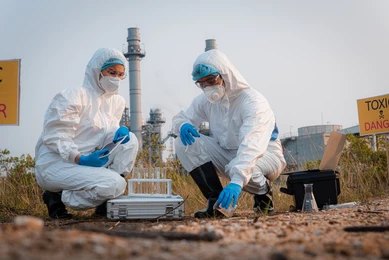
A Phase 2 environmental site assessment moves from desk research into physical evidence.
- Consultants drill boreholes or dig test pits, install monitoring systems, and collect site samples at targeted locations
- Samples are submitted to NATA-accredited laboratories, and results are compared against the investigation levels according to the ASC NEPM
- Where concentrations exceed the relevant screening criteria, the report outlines the implications for development, remediation cost, and regulatory sign-off
When Does a Phase 1 Trigger a Phase 2?
Not every property needs both stages. A Phase I ESA that finds no evidence of historical contamination, no listing on a government contamination register, and no other red flags during site walkover, typically concludes the due diligence process. But if it does find any evidence, that is what triggers a Phase 2 assessment.
Liability in Australia generally follows the current landowner, not the historical polluter. Contamination discovered years after settlement can still become the new owner’s remediation cost, which is exactly the exposure a Phase 1/2 assessment is designed to price in before purchase.
Most investors do not ask for a Phase 1 ESA or a Phase 2 by name; you might describe a transaction and need to know what due diligence it calls for. The table below maps common scenarios to the likely pathway.
| Investor Scenario | Likely Pathway | Why |
|---|---|---|
| Vacant commercial land, no known industrial history | Phase 1 only (unless flags emerge) |
Low prior likelihood of contamination; desktop review usually sufficient |
|
Acquiring a former service station or dry cleaner |
Phase 1, almost always followed by Phase 2 | High-risk land use with well-documented contamination potential |
| Lender requires due diligence before settlement finance | Phase 1 minimum; Phase 2 if risk rated moderate/high |
Lenders use the Phase 1 outcome to decide whether Phase 2 is a finance condition |
|
Redeveloping a former industrial or landfill site for residential use |
Phase 1 and 2 ESA, likely with Site Auditor sign-off | Sensitive land use (residential) demands the highest evidentiary standard |
| Portfolio acquisition across multiple properties | Phase 1 across all assets; Phase 2 only where flagged |
Cost-efficient triage; concentrates intrusive work on genuine risk |
Table 2: Investor Scenario Guide – Which Assessment Applies?
A Sydney investor acquiring a former dry-cleaning tenancy for adaptive reuse commissioned a Phase 1 before exchange. It flagged historical solvent use, triggering targeted soil-vapour testing that confirmed low residual risk, allowing settlement to proceed on schedule.
Cost, Timeframes & What to Budget For
Since an ESA Phase 2 involves fieldwork, drilling equipment, and laboratory analysis, it costs substantially more than a Phase 1 and takes longer to complete. Here’s a typical idea for you to understand how to budget your project and site assessment accordingly.
| Cost/Time Driver | Typical Impact |
|---|---|
| Site size & sample count |
Small residential-scale site: ~5–10 soil + 2–3 groundwater samples; larger industrial site: 30+ samples |
|
Drilling method |
Hand auger (lowest cost, shallow) vs sonic/rotary drilling (higher cost, deeper access) |
| Laboratory turnaround |
Standard analysis: 2–3 weeks; express turnaround available at additional cost |
|
Contaminants of concern |
Petroleum hydrocarbons are fastest/cheapest to test; heavy metals, asbestos, and PFAS (testing is governed by the PFAS NEMP alongside the ASC NEPM) add cost and time |
| Groundwater monitoring wells |
Installation and multi-round monitoring add both cost and multi-week/monthly timelines |
|
Statutory Auditor Schemes (e.g., NSW, VIC, QLD, WA) |
Adds independent review time and fees for higher-risk or rezoning sites |
Table 3: Phase 2 ESA Cost & Timeframe Drivers
Common Mistakes Investors Make
Even experienced investors misjudge how the two stages work together. So here are some scoping mistakes to avoid:
Treating Phase 1 as a formality rather than a genuine risk filter, and skipping it on “low-risk-looking” sites
Assuming a clean ESA Phase 1 removes all liability, when a moderate-risk rating still warrants Phase 2 sampling
Engaging a consultant without confirming ASC NEPM and AS 4482 compliance, weakening the report’s legal standing
Skipping Phase 2 on land-use changes (e.g., commercial-to-residential) where sensitive use demands a higher evidentiary bar
A regional Queensland developer proceeded to purchase after a Phase 1 flagged former pesticide storage sheds, without commissioning Phase 2 sampling. Post-settlement soil testing revealed organochlorine contamination, delaying the project eight months and adding significant unplanned remediation costs.
Conclusion
For investors, the choice is rarely between the two assessments; it’s about sequencing them correctly and acting on what each state reveals. A well-run offsite review followed by intrusive testing, where warranted, protects your capital throughout the project.
Looking for Trusted Environmental Site Assessment Services? SERS Can Help You!
We offer professional site assessment services and due diligence reports! Our experienced consultants will keep your site assessment sequence efficient. Contact us now!
Frequently Asked Questions
Who is Legally Authorised to Sign Off on a Phase 1 or Phase 2 Esa in Australia?
Certified Environmental Practitioners (CEnvP) or Certified Professional Soil Scientists (CPSS) typically author and endorse compliant Australian assessment reports.
Can an Investor Rely on an Existing Phase 1 ESA Provided by the Vendor?
Vendors’ reports often lack legal reliance for buyers, and desktop reviews generally expire after six to twelve months.
What Happens if a Phase 2 ESA Confirms Contamination on the Property?
Investors must notify regulatory authorities, quantify remediation costs, and negotiate purchase price adjustments or seller indemnities before exchange.
Does Commercial Property Insurance Cover Pre-existing, Undiscovered Site Contamination?
Standard commercial property policies exclude pre-existing contamination; specialised environmental impairment liability insurance is required to cover historical pollution.
How Does Site Contamination Affect Commercial Property Valuation and Bank Lending Terms?
Lenders typically reject loan applications or lower loan-to-value ratios until remediation costs are quantified and legally ring-fenced.