


The hierarchy of controls is a system that can be used for classifying the safety measures in order of effectiveness. This blog will explore how it can be used to help you prevent workplace hazards daily.
What is the Hierarchy of Controls
The hierarchy of controls is a method that is capable of identifying and ranking safeguards for the protection of workers from hazards. They are usually arranged from the most to the least effective. And the control measures are:
- Elimination
- Substitution
- Engineering Controls
- Administrative Controls
- PPE
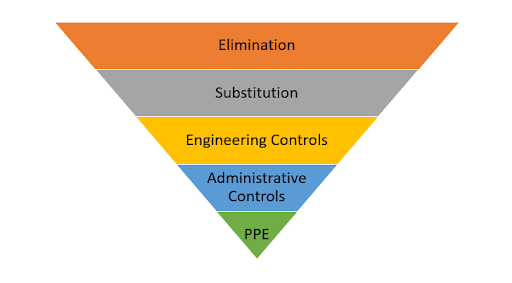
And based on this list, here’s a pyramid chart exploring the hierarchy of controls from most to least effective:
Why the Hierarchy of Controls is Important
The hierarchy of controls acts as an extremely useful tool that helps safety professionals to identify the most effective ways to control a specific hazard.
By applying the hierarchy of controls, employers can ensure that the most effective measures are being taken to protect the employees from potential hazards.
When faced with a specific workplace hazard, the hierarchy of controls can be applicable as a step-by-step process that determines the best course of action that can be applicable in the control or elimination of the hazard.
Hence, when the question of “what is the hierarchy of controls” is asked, the right answer becomes that it is a helpful tool that facilitates the development of a hazard control plan. And in this plan, the selected controls can be implemented in the workplace.
The Best Practice for the Hierarchy of Controls: What Are the Measures?
The best practice for the hierarchy of controls is to combine control methods for the best protection of the workers. And here is how the different control measures work:
Level 1: Elimination
Elimination is the top layer of the reverse pyramidal structure that represents the hierarchy. It holds that position due to being considered the most effective way to control a hazard. Since this procedure effectively works by completely removing the hazard from the workplace, it is considered the most effective preventive measure.
This procedure can effectively prevent any form of potential harm or injury from ever taking place, as it eliminates the hazard completely. A correct example of this can be removing a machine that consistently releases toxic gases.
Level 2: Substitution
Substitution is the second-most effective hazard control measure, positioning it right below elimination on the pyramid. This process involves replacing a hazardous material or ingredient with something a lot less dangerous. The primary idea here is to replace an occupational risk with something that comes with a considerably lower risk profile.
A common example of this process is: if a chemical used in industrial processes is causing health problems to the workers when inhaled, it is replaced by something that is safer to breathe in.
Level 3: Engineering Controls
Engineering controls are placed on the third level. They essentially involve isolating a hazard or making adjustments to procedures to reduce the effects of a hazard. The primary goal in this situation is usually to reduce the exposure to a hazard. Thus, it often involves the addition of safety measures that make work easier.
A very useful example to use this is the installation of exhaust fans and ventilation systems in a packed factory dealing with harmful gases.
Level 4: Administrative Controls
The fourth level of control, after Engineering Controls, this step involves changing entire practices or making critical adjustments to procedures to effectively reduce exposure to potential hazards. These adjustments in procedures can include changes to operational procedures, work schedules, or the introduction of warning signs in the workplace.
Level 5: Personal Protective Equipment (PPE)
The fifth and final level of control, PPE, is considered an essential but also the least effective way to control a hazard. However, when asked “what is the hierarchy of risk control?”, the list is incomplete without PPE.
PPE includes protective gear such as clothing, gloves, or other items that protect the body from being exposed to a hazard.
Final Thoughts
The hierarchy of controls is essential to make a workplace safe from hazards. For the best application of these, the best steps will involve the application of interim controls until long-term solutions can be implemented. They also ensure the defense from the introduction of new hazards, and using a combination of controls is generally ideal.
Want to Implement Hierarchy of Controls at Your Workplace?
The hierarchy of controls will ensure that the health and safety of your workforce is perfectly maintained. While the hierarchy of controls provides a structured approach, many workplaces struggle to implement higher-order controls due to legacy infrastructure, time constraints, or regulatory pressure. Get expert remediation support to implement higher-order controls.
Frequently Asked Questions
Are the Five Stages of the Hierarchy of Controls Fixed?
Yes. The five levels are established with specific logical implications in mind. However, you are free to consider the steps based on the best requirements for your workplace. Combining multiple levels is ideally recommended.
What is the Hierarchy of Risk Control, and is It Different to the Hierarchy of Controls?
The hierarchy of risk control is nothing but another name for the hierarchy of controls. So, no. It is not anything different, and implicates the same steps generally.
If the Elimination Level is Considered, is PPE Still Necessary?
The elimination process is generally not something that can be accomplished overnight. So, while the processes work their charm, PPEs are recommended for the momentary safety of the workers.
Can the Substitution Level Still Be Considered After the Hazard is Eliminated?
Yes, it can be required. Suppose you eliminate a hazard-causing machine, you would need to replace it with a better option.

