
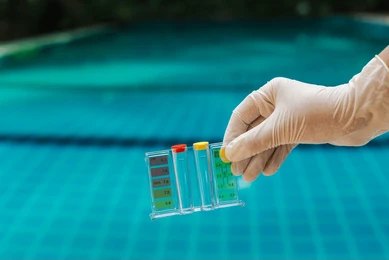
Standard pool tests miss metals, phosphates, and bacteria, causing cloudiness, skin irritation, and green hair. Know how complete environmental testing helps identify source water contamination and remediate hidden pool hazards before costly, dangerous problems arise.
Key Takeaways
- Chlorine checks aren’t enough: Standard testing ignores metals, phosphates, and cyanuric acid that cause pool cloudiness and equipment damage
- Hidden microbial risks persist: Pathogens like Pseudomonas can thrive in clear water, posing unseen skin, ear, and respiratory health risks
- Source water brings contaminants: Rainwater and bore top-ups introduce heavy metals and dissolved solids that standard pool chemicals cannot treat
Most Australian pool owners end pool water evaluation with chlorine and pH testing. It’s a good habit, but it only provides half of the results. Test reports may show nothing alarming, but the pool may still have chemical and biological problems.
These problems usually build up over weeks before symptoms like staining, cloudiness, skin or eye irritation become obvious. This blog will explain the contaminants that standard tests often miss, which cause these symptoms, and why they matter.
Why Chlorine and pH Checks Aren’t Enough
Chlorine and pH stand in the first line of defence, not the whole defence. They tell you whether a sanitiser is present and whether the water is comfortable to swim in; not whether metals, organic residues, or pathogens have accumulated under the “balanced reading”.
Many water contaminants produce no smell, colour, or taste change until the concentrations are already high enough to cause staining, cloudiness, or health issues. Furthermore, Australia’s climate increases the risks with the following factors:
- Intense UV accelerates chemical breakdown
- High evaporation concentrates whatever is left behind
- Pool filled from bore water and rainwater tanks
- Ageing plumbing
All these introduce contaminants that a single chlorine test cannot detect.
Groundwater, PFAS, and Extreme Weather Events in 2026
Across Australia, severe weather cycles- ranging from flash flooding to prolonged droughts- are altering source water chemistry:
Flood Surface Runoff: Stormwater washes agricultural nitrites, heavy metals, and organic debris directly over pool copings.
Bore Water & PFAS Ingress: Private boreholes in urban-fringe and regional areas (especially near industrial or defence sites) face increasing risks of heavy metal leaching (arsenic, lead, copper) and persistent PFAS (per- and polyfluoroalkyl substances) contamination.
Groundwater Seepage: Unsealed or aging concrete pools situated in high water-table zones can experience reverse-osmosis ingress, where contaminated soil moisture seeps through micro-cracks in the pool shell.
Quick Diagnostic Guide: Symptoms, Causes, and Immediate Actions
| Visual / Physical Symptom | Likely Overlooked Cause | Immediate DIY Action | When to Get Lab/SERS Testing |
|---|---|---|---|
| Swimmers get skin/ear rashes despite “clean” water | Pseudomonas aeruginosa bacterial bloom | Perform a shock dose of sanitiser; scrub low-flow dead zones. |
If symptoms persist across multiple swimmers after shocking. |
|
Swimmers’ hair/nails turn green or blue |
Copper oxidation (from algaecides or bore water) | Add a metal sequestering agent; stop using copper algaecides. | Before topping up from a private borehole or tank. |
| Water remains cloudy after repeated shock treatment | High Total Dissolved Solids (TDS) or “Cyanuric Acid Lock” | Stop adding stabilised chlorine. Perform a partial drain and refill with mains water. |
If using non-mains source water (bore/rainwater) for refills. |
|
Black/brown stains on pool walls or plaster |
Iron or Manganese precipitation | Test water metal levels before using harsh acid wash chemicals. |
If stains reappear within 48 hours of cleaning. |
Table 1: When Lab Testing of Pool Water is Necessary
Chemical Contaminants Australian Pool Owners Miss
Metals, phosphates and stabiliser build-up rank among the leading causes of poor water quality in Australian backyard pools. However, none of them show up on a standard test strip.
| Contaminant | Common source | Why it’s overlooked | Effect if ignored |
| Phosphates | Fertiliser run-off, tap/rain water, some algaecides | Not part of standard chlorine/pH strips |
Feeds algae; reduces sanitiser efficiency |
|
Copper |
Bore water, corroding copper pipes/heat exchangers, algaecides | No taste or smell until levels are high | Green hair/nail staining, blue-green tinge |
| Iron | Bore water, ageing metal pipework | Invisible until it oxidises |
Rust-brown staining, persistent cloudiness |
|
Aluminium |
Alum-based clarifiers, some coagulants | Rarely tested outside commercial facilities | Cloudiness, filter media clogging |
| Cyanuric acid (stabiliser) | Stabilised chlorine products (trichlor, dichlor) | Builds up silently; never dissipates on its own |
“Chlorine lock” – sanitiser efficiency plummets above 50 mg/L and can cause “chlorine lock” above 100 mg/L, making the sanitiser ineffective even when test strips read normal. |
|
Ammonia/ combined chlorine |
Sweat, urine, sunscreen, organic debris | Total chlorine tests can mask it |
Eye/respiratory irritation; strong “chlorine” smell that actually signals low sanitiser |
Table 2: Commonly Overlooked Chemical Contaminants
Cyanuric acid never evaporates or breaks down. It only leaves a pool through dilution, so seasons of stabilised chlorine use can quietly push levels past the point where chlorine stops sanitising effectively, even when test strips look normal.
Biological and Microbial Risks Beyond Chlorine Readings
A chlorine test confirms the presence of a sanitiser, not the poor water quality or whether it’s working. Microbial contamination is a major driver of unsafe swimming conditions even in pools that look pristine and test “clean” on paper.
While public pools follow strict microbial benchmarks, private pool owners rarely test for these organisms at all, relying instead on visual clarity. Here are the contaminants that are invisible to the naked eye.
| Organism/parameter | Health risk | AS 3633 reference guidelines | Typical test method |
|---|---|---|---|
| E. coli/total coliforms | Gastrointestinal illness | Not detected in 100 mL |
Lab culture/membrane filtration |
|
Pseudomonas aeruginosa |
Skin rash, ear and eye infections | Not detected in 100 mL | Lab culture |
| Naegleria fowleri/ thermophilic Naegleria | Rare but severe brain infection risk | Not detected |
Specialist lab PCR/culture |
|
Total dissolved solids (TDS) |
Indicator of accumulated organic/inorganic load | Under 1,000 mg/L guideline; historical absolute ceiling ~3,000 mg/L |
Conductivity meter or lab test |
Table 3: Microbial and Pathogen Risks Beyond Standard Kits
A Perth family’s backyard pool tested clear on chlorine and pH for months, yet swimmers kept developing ear infections. A microbial panel later found Pseudomonas aeruginosa thriving in a low-flow corner the ageing filter wasn’t reaching effectively.
When Your Fill Water is the Real Problem
Not every contaminant originates in the pool. Many enter with the water used to fill or top it up. Pools topped up from bore water or rainwater tanks can inherit contaminated water straight from the source, before any chemical is added.
A history of poor quality of water from the household tap is a strong signal to test pool water for the same source contaminants. This is because both often draw from the same bore, tank, or mains connection.
Soil-to-Pool Ingress: Is Contamination Entering Through Your Pool Shell?
It is a common misconception that pool water contamination only comes from the surface or top-up taps. In areas with high groundwater tables or recent flooding, hydrostatic pressure can force surrounding soil water through porous concrete, cracked plaster, or faulty hydrostatic valves.
If your property is located near historical industrial land, agricultural zones, or acid sulphate soil (ASS) regions, contaminated groundwater can quietly compromise your pool water chemistry from the outside in. Signs of structural groundwater ingress include:
- Unexplained, rapid drops in total alkalinity despite regular dosing.
- Persistent, localised wall staining near floor drains or structural return lines.
- Recurring bacterial blooms that reappear within 48 hours of heavy shock chlorination.
Properties already flagged for poor drinking water by a local water authority or prior testing should implement the same checks to their pool, instead of assuming that pool chemicals will neutralise whatever contaminant the source water brings in.
Recommended Testing Parameters and Frequency
The table below reflects AS 3633 and health department reference ranges for private pools.
| Parameter | AS 3633/health guideline range | Recommended frequency | Test type |
|---|---|---|---|
| Free chlorine | 1-3 mg/L (2-3 mg/L minimum where stabiliser is used) | 2-3 times weekly |
DIY strip/liquid kit |
|
pH |
7.2-7.8 | 2-3 times weekly | DIY strip/liquid kit |
| Total alkalinity | 60-200 mg/L | Fortnightly |
DIY kit |
|
Calcium hardness |
80-500 mg/L (AS 3633); 50-400 mg/L per WA guideline | Monthly | Pool shop or lab test |
| Cyanuric acid (stabiliser) | 30-50 mg/L | Monthly |
DIY strip (allow 24-72 hrs for newly added stabiliser to fully dissolve before testing) |
|
Total dissolved solids |
Under 1,000 mg/L (Freshwater pools) / 3,000-6,000 mg/L (Saltwater pools) | Every 3-6 months, or after heavy rain/top-up | Conductivity meter or lab |
| Metals (copper, iron, aluminium) | No safe taste/odour threshold – test-based only | Every 3-6 months, or after bore water top-up |
Lab or specialised strip kit |
|
Microbial panel (E. coli, Pseudomonas, etc.) |
Not detected | Annually, or after suspected contamination/illness |
NATA-accredited lab |
Table 4: Recommended Testing Parameters & Frequency, Home Pools
A Gold Coast property switched from mains to rainwater-tank top-ups during drought restrictions. Within a season, elevated TDS and trace metals from the tank’s roof catchment left the pool cloudy despite textbook chlorine and pH readings.
4-Step Post-Storm Action Checklist for Australian Pools
Heavy downpours bring atmospheric nitrogen, phosphates, and soil runoff directly into your pool. Follow this checklist after severe weather:
- Step 1: Lower Water Level & Skim: Drain excess water to normal operating height (halfway up the skimmer mouth) and clear physical debris immediately.
- Step 2: Check pH First: Heavy rainwater drops pool pH rapidly. Adjust pH to 7.2-7.6 before adding shock chlorine, or the sanitiser will be inactive.
- Step 3: Test for Phosphates: Rain carries airborne fertilisers. Add a phosphate remover if levels exceed 0.2 mg/L (200 ppb) to prevent sudden algae blooms.
- Step 4: Run Filtration 24/7: Run your pump continuously for 24-48 hours until water clarity is restored and total dissolved solids settle.
Conclusion
Chlorine and pH are necessary checks, not complete ones. The contaminants most likely to be missed are also the ones most likely to trace back to the water source itself. A comprehensive pool water test, backed by professional environmental assessment where source water is in question, is the only way to know what’s really lurking in your pool.
Your Pool Water Might Include Harmful Contaminants. Get It Tested Today!
At SERS, our water testing traces contamination back to its source- soil, groundwater, or historical land use- rather than treating only the pool symptoms. Hire our environmental assessment and remediation services to make sure your pool is safe to use!
Frequently Asked Questions
Can Salt Chlorinators Prevent These Overlooked Contaminants?
No. Salt chlorinators only generate chlorine; they do not eliminate metals, cyanuric acid build-up, or excessive total dissolved solids.
How Does High Cyanuric Acid Affect Pool Water Balance Models Like LSI?
High cyanuric acid lowers your Langelier Saturation Index, artificially inflating alkalinity readings and skewing overall water balance calculations.
Does Swimming Pool Backwashing Help Remove Heavy Metals?
Backwashing removes trapped debris from filters, but dissolved heavy metals remain in the water until chemically sequestered or drained.
Will a Pool Cover Prevent Phosphate Contamination?
Pool covers block windblown organic debris and leaves, significantly reducing phosphate entry, though source top-up water may still introduce them.
Can Shocking a Pool Resolve High Total Dissolved Solids?
No. Shocking adds chemical compounds, which actually increases total dissolved solids. Dilution via partial draining is the only solution.